Confederate Shop

Written by James Reed (of the Edney Grays), Asheville, North Carolina
In April 1861, at Edneyville, Henderson County, North Carolina a company of volunteers was organized, taking the name of Edney Grays. Their commission was dated May 15. Their officers were: Captain Balas M. Edney; Lieutenants Matthew N. Love, Joseph H. Freeman, and John C. Edwards; Sergeants James P. Sawyer, John B. Plumblee, James Maxwell, Isaac M. Lydia, and Ambrose A. Featherstone.
In due time we moved onward to Asheville, arriving there in the afternoon. With much pomp and patriotic pride we marched up Main Street. Having marched through the town we went into camp with the Haywood Invincibles, a company made up in Haywood County and commanded by Captain Sam C. Bryson.
Sam Sumner became the barber, and cut our hair so short that our heads resembled freshly hulled walnuts. This duty exempted Sam from drill. Joe King 'lowed his foot was too big for the business, anyhow.
The time finally came, however, for us to leave Asheville for Raleigh, where we halted for a few days, and then moved on to Wilmington, where we arrived about midnight and camped seven miles below the city, on Mitchel's Sound.
The next morning a fusillade of words and oaths was exchanged between two messmates, Drake Nelson and John Bell, about the coffee. Each accused the other of putting salt in his cup. They had taken the water for the coffee out of the sound, which they thought was a river. They were soberly informed by Carey Payne that the Atlantic Ocean was salty. We had scarcely gotten through breakfast when an old "sager" (so-called by the mountaineers) came with fish to sell, and among the lot was one that to us appeared to be deformed. One side was white, the other black, and both eyes were on the same side of its head. When we called the old man's attention to this, he said, "Oh, that fish is a flounder." Lump Freeman asked him where in the world he had been floundering to get himself in such a shape as that.
After our return to camp, Bill G. Conner concluded to give Jonathan Nix a whipping, but Jonathan was (as Bill afterwards expressed it) "too contrary." Bill changed his mind, and called on Poss Conner and Anderson Head to help him make "Johnce" behave himself. Here the captain had a gymnastic pole put up for the boys to act upon by skinning the cat and hanging by their heels—as the captain termed it, "to develop their muscle." Obe Conner tried to hang by his heels and fell. Lum Maxwell said, "Obe developed a good size muscle on his head." Uncle Cal Edney offered to bet five dollars that the captain could hang longer by his chin than any man in the regiment. Captain Edney, thinking that Cal meant to cast a reflection on his long jaw, got mad, cussed Cal, and had the pole torn down.
When we left Charleston, we moved toward Savannah and stopped between the Coosawhatchie and Pocotaligo Rivers near a village called Grahamville. Here we drew our first pay of Confederate money. This led quite a number of the boys to see the importance of possessing a timepiece, so they sent Lieutenant Edney to Charleston for a lot of watches. In a week's time it would have been impossible to find out the correct time, as every man claimed his watch was right, and no two of them were the same.
Here the regiment became infested with malaria, and Dr. Satchel, the regimental surgeon, recommended a little whiskey, which he had issued from the hospital tent in the mornings. It wasn't long before the malady became chronic. The doctor soon cured this, however, for he gave them something with the whiskey, and, as Uncle Joe Lydia expressed it, "They had the pleasure of tasting their liquor twice—going and coming." Sam Wheeling said that as he was going for his dram one morning he met Brock coming back. All at once Brock began to scrape and bow, heave and hump, and he lost all his whiskey, all the ginger cakes he had eaten the day before, as well as the taste for Dr. Satchel's whiskey. Sam said that Brock's calamity cured him (Sam), and he did not trouble the doctor for his drink that morning.
Jim Sawyer, John B. Edney, Isaac Lyda, and Milt Fortune, to prevent malaria, took a few doses of stolen booze, which seemed to make them feel rich. At the same time it enraged Captain Edney, and he threatened to have the "Rogue's Roll" played after them! Sawyer told him he would have to play it himself, as he appeared to be the only one who knew it.
We went into camp on Swift Creek on June 20, 1862, where we stayed for four days, and then moved to Richmond. There we camped around and in the capitol building. The next morning early we moved out in the direction of the White Oak Swamps, where we met Seagle's Division; and as Obe Conner said, "This was something else." Prose Conner was shot through both legs and both arms at the same time. (I will not write of the killed and wounded, but only of the peculiar incidents.)
While Cary Payne was going to the rear to have his wound dressed he was stopped by General Ransom, who asked him if he was badly hurt. Cary said, "No, it's nothing but a scratch; just enough to fool the doctor." The general then asked, "How do you like the fighting?" "Oh, General, it's a fine sport, but a leetle bit dangerous."
A squad of Grays, having been sent out to skirmish, were caught between two fires. It goes without saying that they hugged the ground very closely, and realized for the first time what it was to be scared. John Lyda will tell you to this day that his legs did him a greater service that day than ever before or since.
We were the victor in every battle and skirmish until we got to Malvern Hill, and John Summy said, "It would have been better if we had left that Malvern Hill business alone." We moved back to Richmond and Drewry's Bluff. Here the regiment put on quite a different appearance. Company A numbered more than one hundred when they left North Carolina; now not 20 answered roll call.
While one of the sharpshooters was in front of the regiment he found his ammunition was getting low, and this caused him to plunder a dead Federal. He took off cartridge box, haversack, and can-teen. The canteen is preserved by its captor to this day. The haversack was well stocked with hardtack and bacon, which of course were very acceptable at that time.
It was here that Ben Enloe discharged his gun with the muzzle near George Edney's ear. This so enraged George that he reached for a rock to throw at Ben, who jumped behind a tree on the side next to the enemy. It seemed that he would rather risk a Yankee bullet than a rock thrown by one of his own men.
When night came and all was quiet, Claibe Freeman thought it was a good time to get himself a better pair of shoes by slipping them from a dead man nearby. As he attempted to take them from the "corpse" it told him to "Hold on there!" Claibe said he was sorry, but he had mistaken him for a dead Yankee. The man said he was not a dead Yankee, and if Claibe tried that again he would find him to be one of the liveliest rebels he ever met.
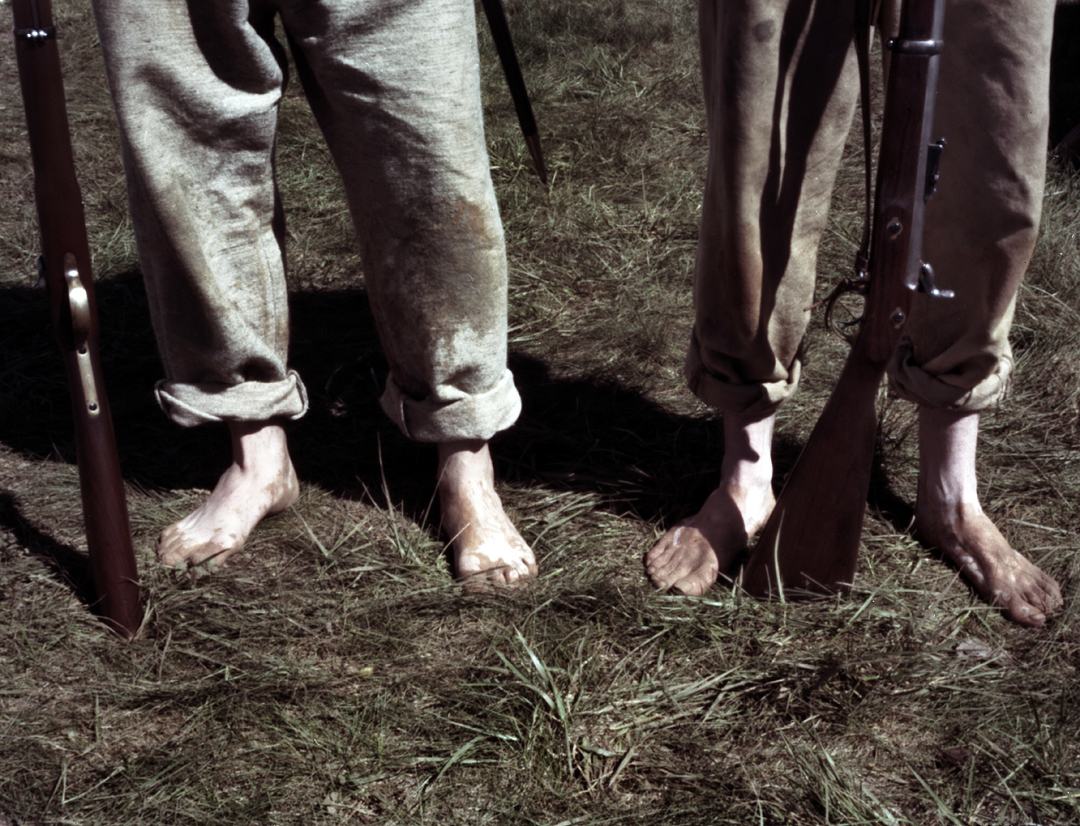
From here we moved to Upperville. We had no blankets; and when one night a hard storm came up and rained out our fires, it was really one of the gloomiest times of the war.
It was now October, the nights were getting cool; and as we had lost our blankets, we "kinder doubled up an' slept in piles" like so many pigs. In such situations the tall ones did not fare as well as the shorter ones. Such fellows as Jesse Maxwell and Wesley Love were bound to suffer with the cold, but they were handy to look over high places. The shorter ones did not envy them—their high places—unless it was when we struck a persimmon tree.
When we moved again it was in the direction of Fredericksburg. It was a hard, muddy march, and rain fell on us nearly all the way. It was impossible to do any cooking, especially baking of bread. Cary Payne tried to eat his dough raw, but finally declared that he could not be a hog and a soldier too. So he haversacked it and carried on.
It was now late November, and we stopped in the neighborhood of Fredericksburg, where we went into temporary winter quarters.
On the morning of the eleventh we were awakened by two blank cannon shots, which was the signal that the enemy was to cross the Rappahannock. We were hurried out and down to the town, where we were held in readiness until the morning of the thirteenth. A regiment was wanted to cross Marye's Heights behind the stone wall in front of the town, and ours was the one chosen by General Longstreet. (History has it that it was the 24th Regiment, but this is a mistake.)
The 25th Regiment was the only one to cross the Heights. We were led by Colonel Sam Bryson. We got in position with the Georgians behind a stone wall at the foot of the hill. It did not take more than two minutes to make the run, but during this time more than one hundred of the 25th fell. The enemy made several attempts to take the works, but was defeated with great loss. When night came, we were relieved and sent back. There was no more fighting that night, and little shelling and sharpshooting the next day. The enemy recrossed the river and gave up the fight at that point. General Burnside was relieved of his command.
We camped near what was called the Richmond bone yard. The next morning John Hutchinson looked around and declared he was insulted, as President Davis had us taken to the wrong place. He wanted it understood that our bones were not to be left there yet.
Our next move was to North East River. Here some of the boys got a possum, and it was so thin that Jasper Williams proposed to throw in a piece of bacon for a share of the possum. Still, it was too thin to be good, and if the Confederacy had not been in narrow straits for supplies, we would never have eaten that possum. We returned to Goldsboro, where we met the captain and several of the boys whose wounds had healed sufficiently to enable them to return to service.
After remaining in Trenton a short time, we returned to Kinston but only to stay until we were detached to General Daniel's Brigade at Washington, North Carolina, on the Tar River. Our commissary wagons failed to get up to us, and we tried to borrow rations from Daniel's commissary; but they would not loan to us. It was plain that something would have to be done, so some of the Grays arranged what they called a "raiding party." That night a hog pen was raided, and the next day a search was made for the pork. Major Grady was called on to assist in the investigation. The major was a good officer, and one of the best men in the army; but he did not understand how to hunt for pork. A part of it was under the captain's bunk, but the captain did not know that. In a short time it was known that two men had deserted during the night. That ended the search, for it was taken for granted that Lum Wright and Bob Stepp had the five hogs.
From here we moved to Gum Swamp, a few miles below Kinston, where the enemy came very near getting the regiment surrounded. Not many were hurt but we got one of the worst scares of the war. Some of the boys wanted to fight, some prayed, some swore, and nearly all wanted to run if they could get the chance. John Summy said that when the Yankees saw that we were about to get down to business they made a gap in their lines and let us out.
Our next move was to Drewry's Bluff, where we met Burnside. Both lines extended across the Richmond and Petersburg turnpike and railroad. During the battle the Grays were thrown out to skirmish in front, and the division was moved to the left. This drew the Grays in front of Clingman's Brigade. Clingman ordered a charge, and Company A went into it with them and carried the works. It was one of the battles where the two lines came together and clubbed each other with their guns. Some of the enemy surrendered and some ran, but the ones that ran fared the worse. After quiet was restored, General Clingman sent us back to our own (Ransom's) brigade.
General Ransom had been wounded, and Colonel Rutledge commanded the brigade until the battle was over. It was here that Company A discarded the Mississippi rifles for new Enfields, which we had captured from the enemy.
We arrived in the vicinity of New Bern, and had the place about captured when we received orders from General Lee to return to Virginia. We started at night; the road was through a swampy country, with ditches on each side. Tom Case fell into a ditch on an old abandoned artillery horse, and he said that at first he thought he had fallen on an alligator and that it was going to attack him. Wesley Love suggested that a horse might have thought he was in contact with an alligator.
We had several wagons loaded with corn; and as our rations were short, we helped ourselves to the raw corn. Pink Johnson declared that 10 ears of corn were not enough to feed a horse at a meal, for he had eaten 14 and was still hungry. Next morning we stopped in the ruins of a small town which had been burned. We started fires in the fireplaces, and parched and ate corn with a relish. In due time we were back in Virginia, and we met Butler's forces at Bermuda Hundred, near a church below Richmond between the James and Appomattox Rivers. We fought, shelled, and skirmished for three weeks. It was here that some of the men got blind at night, and had to be led by those who could see. It fell to Burgin Whitaker to lead Joe Mitchell one night, and to make sure Joe was not putting on, Burgin led him into a ditch. After Joe had fallen in, Burgin told him, "Look out. There is a hole!" Joe said it was a "dadburned scamp that would treat a blind man that way." It was here also that the Federal pickets and ours exchanged tobacco for coffee. They would get up a hot firing, and Minié balls would fly thick for a while; then some Yankee would say in an undertone, "Johnny, if you will meet me halfway I will give you some good coffee for some good Dixie tobacco." We always found Mr. Yankee as good as his word; and when the exchange was completed and future arrangements had been made, he would say, "Now, Johnnie, we had better get back to our places before an officer comes." The officers would quarrel with us and threaten punishment when they found out we had been trading with the Yankees, but they would drink the cup of real coffee with great enjoyment and read the Yankee newspapers with interest.
There were many more incidents of this nature, but the writer was taken prisoner here, and not able to note those that occurred between that time and April 9, 1865. Suffice it to say that on that day we realized that our "cause" had failed, and that we were conquered subjects; but we were not yet convinced that states' rights were not right.
It was then that the Confederate soldier laid down his gun, took leave of his chief, rolled his dingy blanket for the last time, swung on his empty haversack and canteen, and started for his home to meet his wife or his mother, sister, and father, and go to work to regain what he had lost.
He holds no ill will against the foe who overcame him; but he detests the Northern carpetbagger, the most atrocious brute of the human kind. Yes, he can shake the hand of the old Union soldier, but for the carpetbagger he has contempt.
But we are rapidly passing away, nearing the end of the long march. Soon the sultry suns and the dust of time will have done with us forever. As we near the Rubicon let us hope that the last battle may be victorious; then we will cross the river, and, in the language of the immortal Jackson, "Rest in the shade of the trees."